ANALYSIS: How to tackle Iran’s Middle East bellicosity
- Get link
- X
- Other Apps
ANALYSIS: How to tackle #Iran’s Middle East bellicosity
https://english.alarabiya.net/en/perspective/features/2017/08/07/ANALYSIS-How-to-tackle-Iran-s-Middle-East-bellicosity.html

Thanks
to years of Western appeasement in the face of Iran’s belligerence
across the Middle East, evidence of Tehran’s dangerous footprints are
now visible in several countries across the region, including even Saudi
Arabia’s Eastern Province.
The
Trump administration, however, has made it quite vivid its adoption of a
firm approach. This stance, signaled in the historic May conference in
Riyadh, is long overdue and should be enhanced by Washington supporting
the Iranian people’s desire for regime change.
A history of devastation
Iran
has a long record of hostility against neighboring countries and US
interests in the Middle East. The 1983 bombings targeting the US Embassy
and barracks in Beirut, the Khobar Towers attack in 1996, all climaxed
in the support Iran provided for Shiite proxies and the Sunni Taliban in
their campaign against US-led coalition forces in Afghanistan and Iraq.
In
parallel form, the Lebanese Hezbollah and Hamas, two known terrorist
groups, have for over 30 years enjoyed contributions from Tehran to fuel
sectarianism throughout the Middle East and carry out terrorist
attacks.
The Obama administration handed Iraq over to Iran in
a silver plate through a strategic mistake of prematurely pulling out
all US troops. This paved the path for Iran to further export its
“revolution” through a convenient medium of extremist proxies.
The
West can literally be accused of standing aside and watching Iran’s
aggressive policy. This has rendered a slate of countries, including Afghanistan,
Bahrain, Iraq, Saudi Arabia, Syria and Yemen feel threatened and/or
left utterly devastated from Iran’s meddling on their soil.
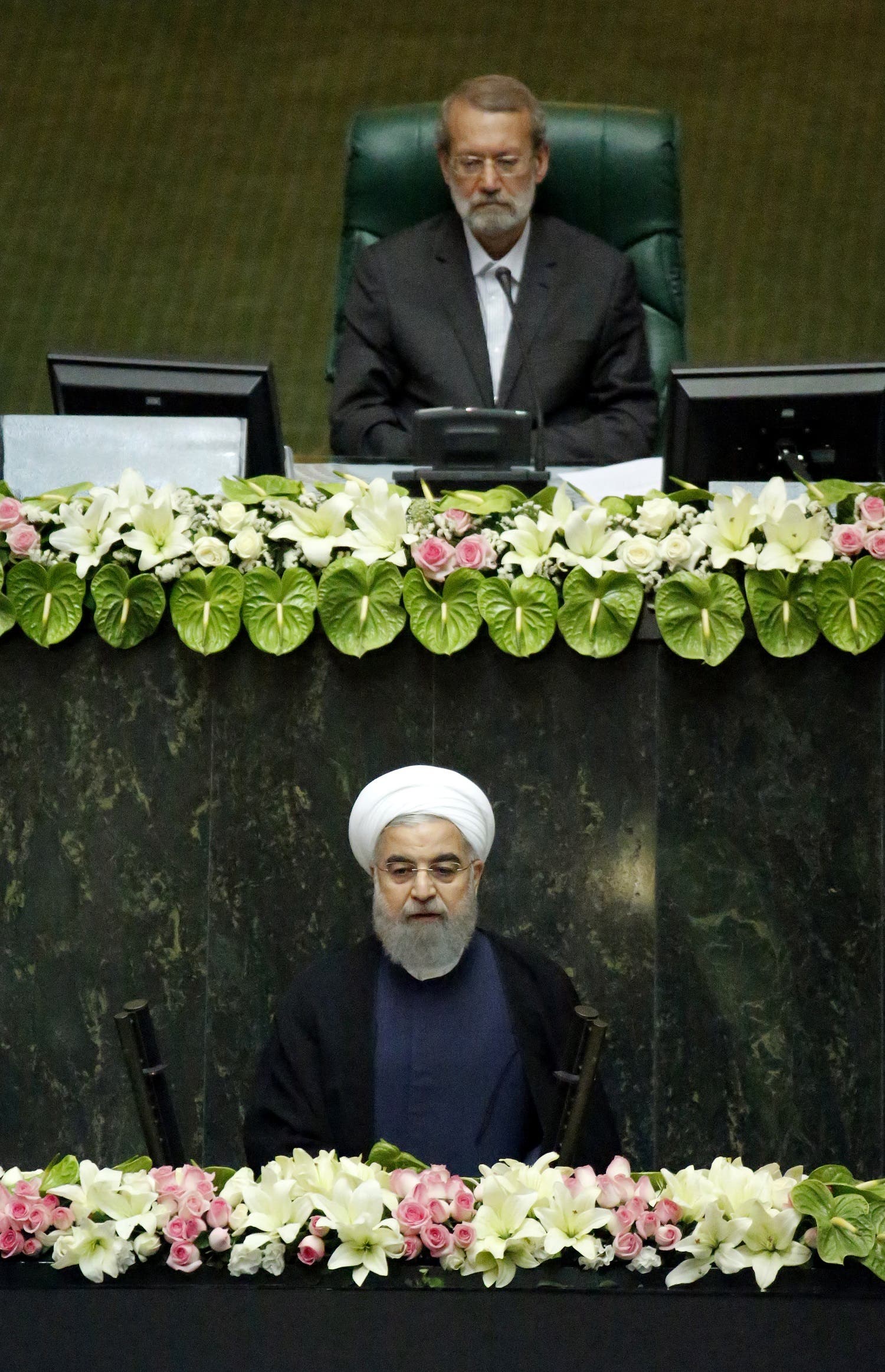
Iran’s
Parliament Speaker Ali Larijani (top-R) attends President Hassan
Rouhani’s swearing-in ceremony in Tehran, on August 5, 2017. (AFP)
Troubling activities
Of
late, Iran has been reported to send further weapons and narcotics to
Yemen’s Houthis. These drugs are sold to provide income for Iran’s
supported militias on the ground in the flashpoint country south of
Saudi Arabia, Tehran’s archenemy in the region.
Members
of Iran’s Revolutionary Guards (IRGC) are present in Yemen also to
instruct and guide the Houthis in assembling weapons smuggled into the
country by Tehran.
“For
the last six months the Islamic Revolutionary Guards Corps (IRGC) has
begun using waters further up the Gulf between Kuwait and Iran as it
looks for new ways to beat an embargo on arms shipments to fellow
Shi'ites in the Houthi movement,” Reuters cited Western and Iranian sources.
“Using
this new route, Iranian ships transfer equipment to smaller vessels at
the top of the Gulf, where they face less scrutiny. The transshipments
take place in Kuwaiti waters and in nearby international shipping lanes,
the sources said.”
The
Iranians are also taking provocative measures against the US Navy in
the same region recently, viewed by analysts as actions to learn the
limits of US President Donald Trump. On July 26th an armed Iranian
patrol boat closed within less than 150 meters of the USS Thunderbolt,
yielding back only in response to warning shots fired by a US Navy ship.
Such
developments are reasons why Trump contacted his French counterpart
Emmanuel Macron “to explore how to increase cooperation in addressing
the ongoing crises in Syria and Iraq and countering Iranian malign
influence,” according to a White House readout.
Positive steps forward
Despite
the utterly wrong decision of EU foreign policy chief Federica
Mogherini visiting Tehran for Iranian President Hassan Rouhani’s
inauguration, the Trump administration is sending push-back signals and
making Iran learn its aggressions will not go without cost.
This is a necessary and welcomed shift in Washington’s foreign policy.
President
Trump has signed into law a strong bipartisan Congressional initiative
imposing strict sanctions on Iran, Russia and North Korea. The IRGC is
now considered a Specially Designated Global Terrorist group.
Considering the Guards’ control over at least 40 percent of Iran’s
entire economy, this raises the stakes for companies considering doing
business with Tehran.
It
would be wise to reconsider investing in Iran’s $400 billion economy
and ponder placing one’s bets in other regional countries, or say, the
United States’ $19 trillion establishment.
And in news that most certainly raised eyebrows in Tehran, Iraqi Shiite cleric Muqtada Sadr visited Saudi Arabia recently
and called for the controversial Iran-backed Popular Mobilization Units
in his country to be dissolved now that the Islamic State has been
defeated.
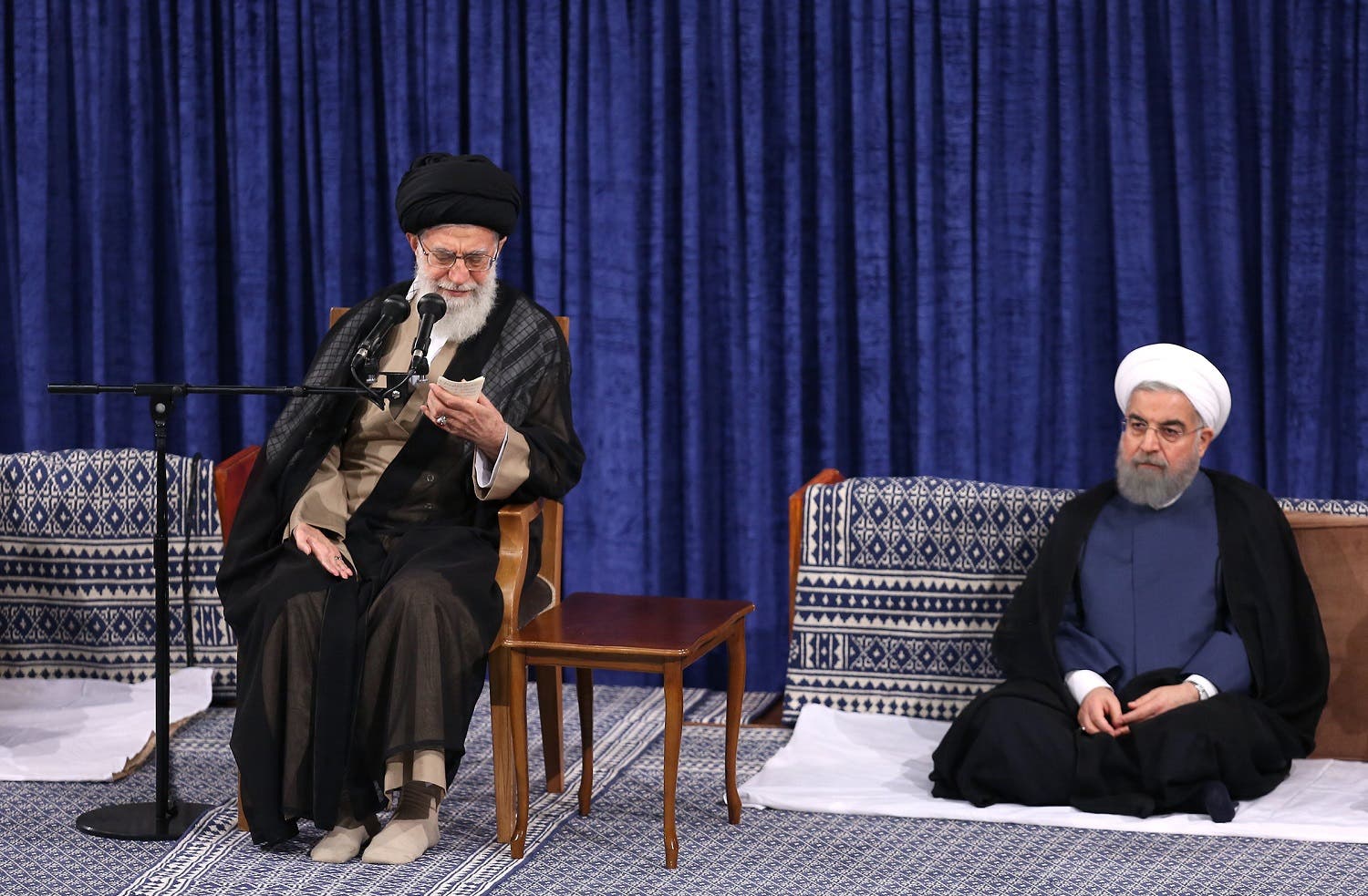
Supreme
Leader Ayatollah Ali Khamenei, left, speaks in the official endorsement
ceremony of President Hassan Rouhani, right, in Tehran, on Aug. 3,
2017. (AP)
The nuclear deal
High
hopes were placed in the nuclear deal sealed between the P5+1 and Iran,
which Obama hoped to leave behind as his foreign policy legacy.
Two
years down this road it has become vivid that Iran’s behavior has not
changed, to say the least. In fact, Tehran’s support for Hezbollah and
other extremist entities have escalated. Iran’s role in the Middle East,
namely Syria, Iraq and Yemen have been horrifically destructive.
The
Trump administration can lead the international community in
instituting the first real and effective initiative against the Iranian
regime.
Any trade with Tehran should hinge on:
- the regime halting all executions and human rights violations,
- withdrawing their forces from Syria and Iraq, and severing any ties and support for terrorist groups,
- completely stopping missile activities, especially ballistic missile production and tests,
- ending all nuclear initiatives and providing true “anytime, anywhere” access to all suspected sites, including military facilities.
- withdrawing their forces from Syria and Iraq, and severing any ties and support for terrorist groups,
- completely stopping missile activities, especially ballistic missile production and tests,
- ending all nuclear initiatives and providing true “anytime, anywhere” access to all suspected sites, including military facilities.
Moreover
and parallel to recent sanctions, which must be executed immediately
and without any loopholes, the Iranian people’s organized opposition,
resembled in the National Council of Resistance of Iran, should be
recognized. This will pave the path for regime change by this coalition
without war or military intervention.
Failure in this regard is tantamount to aiding Tehran’s regime.
- Get link
- X
- Other Apps


Comments
Post a Comment